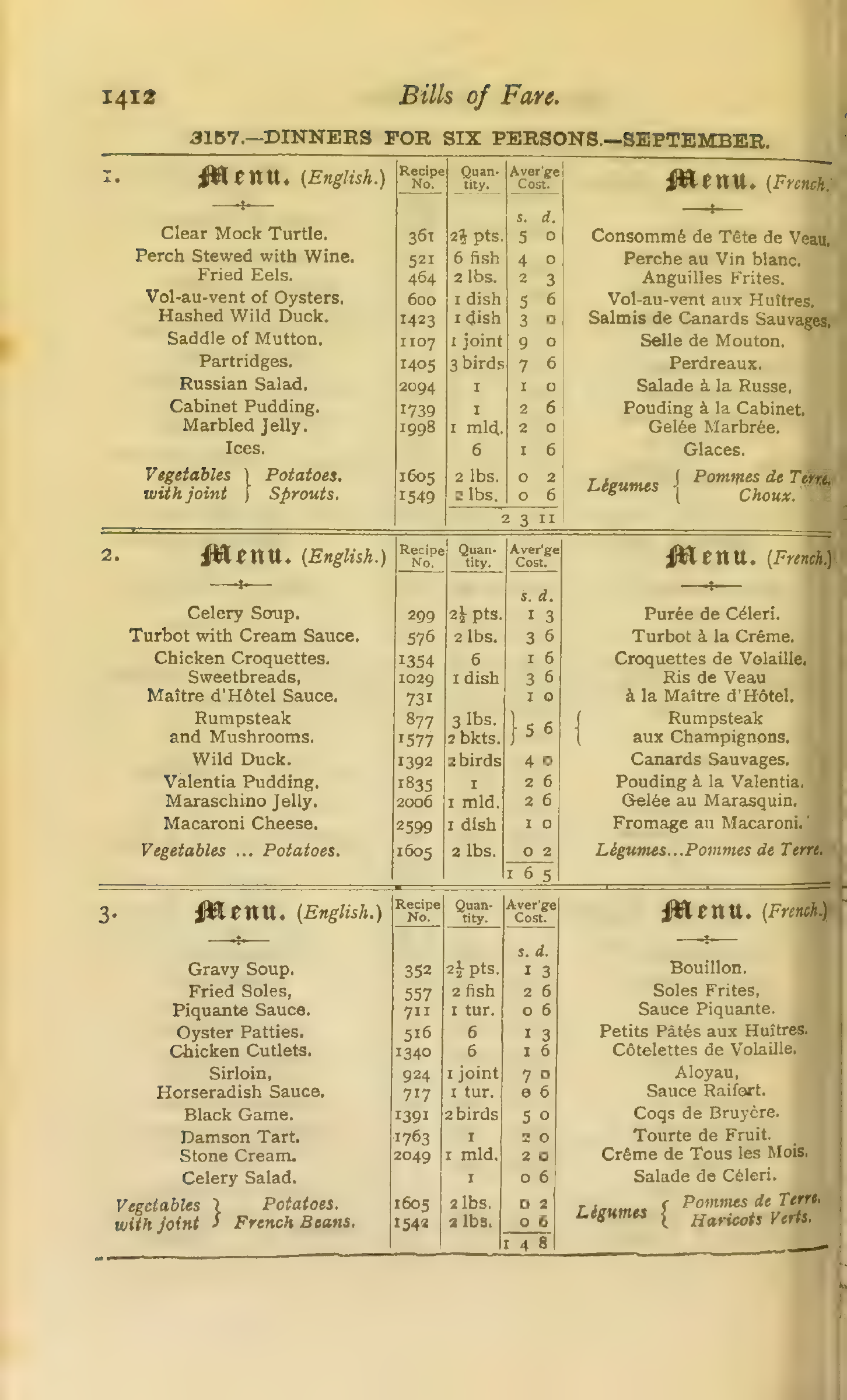
Eleven priced entries. Six diners. One printed estimate. Open the ledger to explore what the book adds up—and the resources its table does not separately account for.
Read the dinner, one entry at a time
Select an entry for its quantity and evidence. Bar lengths are relative to the largest line; shares use the full 317d. total.
Calculated line sum: 317d.Printed total: £1 6s. 5d. ✓
What does “per person” mean here?
Dividing the whole estimate by the six diners named in the heading gives about 52.83 old pence per diner (317 ÷ 6). This is a modern arithmetic mean, not a price printed in the book or evidence of equal portions. It does not establish what any individual actually consumed or paid.
£1 = 20 shillings = 240 old pence; 1 shilling = 12 old pence. Percentages are rounded to one decimal place. No modern purchasing-power conversion is made. Currency notation: Bank of England ↗
From the illustrated book
The visual language of a dinner.
Colour plates show the book’s repertoire of dishes and presentation. Their captions do not identify the selected September dinner or its specific jelly.
Original scans: University of Leeds Library / Internet Archive · Public Domain Mark. Select an image to enlarge it and read its source caption.
Beyond the food estimate
The kitchen behind the ledger.
Food prices, reusable equipment and paid work answer different questions. Explore each layer without combining them into an invented “true total.”
The jelly recipe names a saucepan, a bag and a mould, and calls for ice. Elsewhere, the manual prints supplier-based equipment quotations. These two examples are not extra charges on the dinner bill.
Reusable purchase / p. 90
Two copper jelly moulds
£1 1s.
Specification No. II, headed ‘Suitable for Good Class Houses.’ The amount is for two moulds together, not one. It is a supplier-based purchase quotation, not a cost incurred each time jelly is made.
Specification No. II, continued. The liqueur-jelly method names a bag but does not require this particular stand or prove that it was purchased. This quotation is separate from the meal estimate.
On p. 89 the book says the utensil specifications are drawn from the catalogue of Messrs. Adams and Son, furnishing ironmongers, and offers a 10 per cent cash discount. The displayed quotations are the printed list prices before that discount. The specifications divide households by means and size; their class labels are the manual’s language, not classifications assigned by this exhibition. These are illustrative reusable purchases, not a minimum kitchen budget or the actual possessions of the dinner’s consumers.
The menu’s references let us follow three dishes into their preparation instructions. These summaries describe operations; they are not a reconstructed schedule for the whole dinner.
Celery Soup
Recipe 299 requires cutting celery, boiling, passing it through a sieve, adding stock, simmering, and finishing with cream or milk. It states one hour, but gives no separate allocation of active work, fuel or cleaning.
Tools and materials: A sieve is explicitly named. A cooking vessel is implied by boiling and simmering; no specific material or equipment purchase is required by the wording.
Recipe 576, p. 270, calls for trimming and cutting the cooked fish, melting butter in a stewpan, briefly simmering the sauce and warming the fish. Its stated ten minutes does not include catching, buying, originally cooking or storing the fish.
Tools and materials: A stewpan is explicitly named. The recipe does not establish ownership of a copper vessel, a refrigerator, or any specific fuel system.
Recipe 2006 requires heating and skimming syrup and gelatine, straining lemon juice, filtering the jelly through a bag, setting a mould in ice, and unmoulding. Its ten-minute time line applies only to boiling the sugar and water, not making and setting the whole jelly.
Tools and materials: A saucepan, filtering bag and mould are explicitly named, and the method calls for ice. The quoted copper moulds elsewhere are examples from an equipment list, not proof that copper was necessary or used for this dinner.
Some tasks can overlap; stock, cooked fish and cooling have earlier or unmeasured inputs. The overlapping processes do not yield a supported total duration or labour cost.
The menu has no separate fuel line. Cooking methods require heat, but the stove, fuel, consumption and price for this dinner are unknown. No fuel surcharge has been invented.
No separate menu charge
Work and service
Wages, preparation, serving and cleaning are not separately itemised in the dinner table. The source does not define a complete accounting boundary, so absence of an itemised charge is not proof it was excluded from every estimate.
No separate menu charge
Cooling and storage
The jelly method calls for ice and the turbot starts with cooked remains. The menu provides no separate ice or storage charge and no equipment inventory for the hypothetical household.
No separate menu charge
Earlier preparation
Stock and already cooked fish carry prior inputs. The printed menu does not tell us how those inputs were allocated between meals. A recipe’s finishing time cannot recover their complete cost.
No separate menu charge
The occasion beyond the listed food
No separate wine service, table linen, lighting or room costs are listed. The menu does not establish which were supplied, how they were paid for, or whether this was an observed dinner party.
An unitemised cost is an unanswered accounting question—not an invitation to enter a made-up figure. The source does not define a complete boundary for every estimate.
Return to the source
The numbers are evidence. So are their limits.
September dinner for six
Printed p. 1412 · section 3157 · menu No. 2. The book is catalogued as 1899; its preface is dated November 1888. The estimates are not independently dated market transactions.
The steak and mushrooms have one shared price. The wild duck’s pence digit is obscured by ink: zero is restored by reconciling the other lines with the printed total. Both points remain visible in the data and research notes.
A recommended dinner and estimated prices printed in the book, not a household bill or a record of actual consumption. Catalogue date 1899; preface dated November 1888. No exact market-price year is established. The eleven priced entries below follow the English menu. They are priced lines, not a claim about the number or order of courses served.
1s. = 12d.; £1 = 20s. = 240d. The eleven menu amounts sum to 317d., which equals £1 6s. 5d. Shares are each line’s pence divided by 317, rounded to one decimal place. The per-person mean is 317 ÷ 6 = 52.8333…d., displayed as about 52.83d.; this is arithmetic, not an observed portion price or a historically quoted decimal amount. Rounded shares may not sum to exactly 100%.
Menu No. 2, p. 1412, section 3157, was checked against the scan. Rumpsteak and mushrooms share a single bracketed 5s. 6d. price: the combined amount is counted once. The wild duck’s pence digit is ink-obscured; zero is restored from the visible 4s. and reconciliation with the printed total. The Maitre d’Hotel sauce line supplies recipe no. 731 and 1s. but no independent quantity. All other row quantities and recipe numbers are transcribed below. Abbreviations are expanded in the display. Recipe 2006 is titled Liqueur Jelly, and names Maraschino as an option: it is the menu’s numbered reference, not a separate recipe titled Maraschino Jelly.
Dinner: printed p. 1412, section 3157, menu No. 2; PDF sequence p. 1522; Archive page-number index leaf 1526. The local scan supplies the exact printed evidence.
Equipment context: p. 89, paragraphs 185–186; supplier attribution, household-size distinctions, and cash-discount condition checked visually.
Equipment list: p. 90, Specification II, two copper jelly moulds £1 1s.; p. 91, Specification II continued, jelly bag and stand 10s. 6d., checked visually.
Method checks: p. 149, recipe 299; p. 270, recipe 576; p. 938, recipe 2006. Method summaries are modern paraphrases, not complete transcriptions. The other eight priced entries have menu-level verification only.
Currency notation follows the Bank of England’s education resource: https://www.bankofengland.co.uk/education/education-resources/shillings-to-pounds-converter . No modern purchasing-power equivalent is calculated.
No consumer’s class, income or actual spending is established. The existing p. 7 wage/staffing record is contextual only; no affordability percentage or wage-hours figure is calculated.
Father 6d, mother 6d and three children at 5d each: 27d altogether.
1s 10d
Fuel
The model rounds an average 1½ bags of coal at 1s 3d a bag to 22d per week.
10d
Other household sundries
An allowance of 2d per person for a family of five.
These components make up the 4s 11d sundries allowance in the five-person budget on p.110. Rowntree distinguishes summer and winter coal quantities; his footnote also records a higher winter-1899 bag price. A constructed allowance is not a constant market price.
B. Seebohm Rowntree, Poverty: A Study of Town Life (London: Macmillan, 1901), p.109, Wellcome canvas135. Table, fuel assumptions and footnotes visually inspected 5 November 2026.
Interpretation & evidence limits
Interpretation: Food competed with clothing, heating and small replacement purchases within the investigator’s minimum.
Limit: This is a York weekly household model, not fuel measured for a Beeton recipe or observed spending by a named family. It supplies no per-dish or hourly fuel cost.